
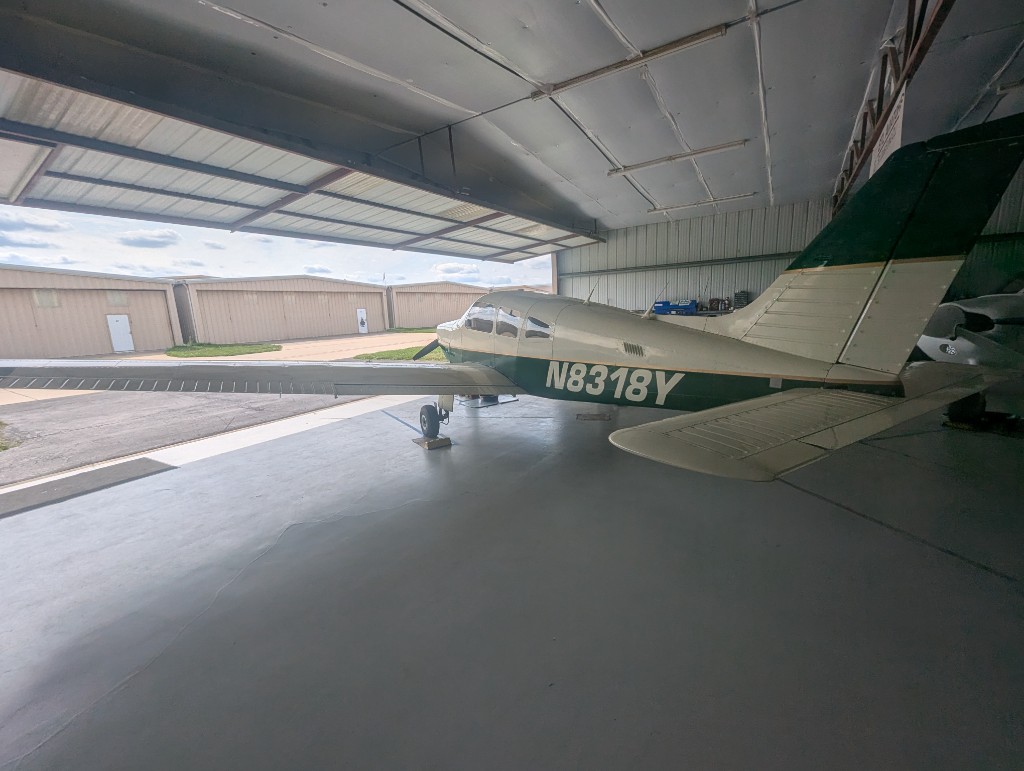
N8318Y is located at Creve Coeur Airport in hangar F-7 (front position; wheel spots marked with blue tape). Lock box code is on Flight Circle.
Aircraft Maintenance Officer: John Signaigo — contact information on Flight Circle.
Fuel, oil & cleaning
Fuel to the tabs — approximately 34 gallons usable. For a long trip, fuel as needed before departure, then return to the tabs when you hangar the airplane.
Use Phillips 66 X/C 20W-50 (blue bottle). Log accurate oil usage when checking the aircraft back in. Clean leading edges with the airframe spray bottle and terry towels; use microfiber and the window spray for the windscreen only.
Leaving the airplane
- Fasten seatbelts across the seats; stow the shoulder harness; leave the cabin neat and clean.
- Do not leave the tow bar on the nose wheel unless your hand is on it — remove it when walking away.
- Navigation position lights: night (sunset to sunrise) and required preflight checks only — daytime use shortens bulb life.
Starting notes
Starter limits: 10 seconds on, 30 seconds cool-down, up to 3 tries, then a 2-minute cool-down. If it does not start after about 5 blade rotations, something is wrong (usually fuel — too little or flooded).
Typically this Archer needs 4 primes (up to 10 when cold-soaked) with the fuel pump on if the engine has not run in the last 90 minutes; about 3 primes with the fuel pump on if starting sooner. Unlock the primer, pull full aft, and count 2–3 (it draws slowly). Lock the primer fully in. Throttle about ¼ inch or less; when cold you may need to pump the throttle while cranking. Fuel pump off after start; on again before takeoff per checklist. If flooded, follow the POH flooded-start procedure.
Operating notes
- No soft-field landings in this aircraft.
- No EGT for leaning — use the fuel flow indicator and POH values; watch oil temperature while leaning.
- Wheel pants are typically installed — avoid snow/ice movement that could damage them.
Basic empty weight
- Basic empty weight: 1,627.9 lbs
- Basic empty weight CG: 86.26 in
- Basic empty weight moment: 140,428.8
- Equipment codes FAA/Domestic: /G · ICAO COM/NAV: SBG · ICAO surveillance: CB2
Weight & balance
NetLeader Aviator Weight and Balance Calculator
FOR EDUCATIONAL PURPOSES ONLY
For educational purposes only. These calculators use the current basic W&B data on file for each aircraft but are not for official flight planning. As Pilot in Command, reference the aircraft POH and the current weight & balance documents for your flight. You are solely responsible for correct, accurate calculations before flight.
Graphs reflect Normal Category limits. For Utility Category, confirm CG envelope data in the POH for that aircraft. Figures do not include start, taxi, and run-up fuel credit.
Calculator tools powered by NetLeader Aviator.
Type specifications
For informational purposes only. These are typical published figures for this type and may not match this airframe exactly. Each pilot is solely responsible for flight planning against the airplane's current POH, weight and balance, and other official documentation (including Flight Circle files).
- Engine
- Lycoming O-360-A4M · 180 HP
- Propeller
- Sensenich fixed pitch · 76 in
- Cruise (75%)
- ~125 KTAS
- Fuel burn (75%)
- ~10.5 gph
- Rate of climb
- ~735 fpm
- Service ceiling
- ~13,650 ft
- Fuel
- 50 gal total / 48 usable
- Max takeoff weight
- 2,550 lbs
- Useful load (standard)
- ~1,134 lbs
- Stall (flaps down)
- ~49 KIAS
- Range (75%, w/ reserve)
- ~565 nm
- Seats
- 4